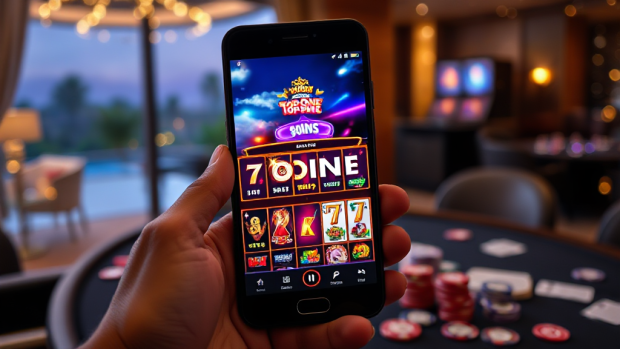
How Different Regions Play TopOne Game
Open the same app in two different countries and you may as well be looking at two different products. The reels spin the same way, the cards deal the same way, and the lobby loads the same way, but almost everything around those mechanics shifts: the language on the buttons, the way money moves in and out, the hours when the tables feel busy, and the kind of help a player expects when something goes wrong. That is the interesting thing about top one game. It is one platform, but it reads differently depending on where the person holding the phone happens to be sitting.
This is not a review of features or a walkthrough of how to sign up. It is a look at the regional personality of a single app. Players in South Asia, Southeast Asia, the Gulf, and parts of Africa and Europe all arrive at the same lobby, yet they bring different habits with them. Understanding those differences explains why one player praises the Telegram support while another barely uses it, and why the same bonus feels generous to one group and ordinary to another.
South Asia: Teen Patti, UPI Habits, and Family-Table Familiarity
For a large share of players in India, Pakistan, and Bangladesh, the entry point into real-cash gaming is not slots. It is cards. Teen Patti sits in a cultural space that other casino games do not occupy, because many players learned some version of it at a family table long before they ever saw a digital deck. That familiarity changes how the app gets used. A player who already understands the rhythm of three-card hands does not need to study a tutorial; they go straight to the table and start reading opponents.
The payment side is just as distinctive. In India especially, UPI has trained an entire generation to expect instant, low-friction transfers. Players there tend to judge a gaming app less on its graphics and more on whether a deposit lands in seconds and a withdrawal does not require a phone call. When that expectation is met, loyalty follows quickly. When it is not, the app gets abandoned regardless of how good the games are.
Support expectations in this region lean heavily on messaging apps. Players often prefer a quick chat over an email ticket, and many will check whether a platform has a responsive Telegram channel before they even deposit. It is less about formality and more about speed, because the whole experience is built around playing in short bursts between work, commuting, and family time.
Southeast Asia: Slots, Small Stakes, and Long Evening Sessions
Move east and the centre of gravity shifts. In the Philippines, Indonesia, Thailand, Vietnam, and Malaysia, slots tend to carry more of the load. Players here often treat mobile gaming as an evening activity, something that fills the hours after dinner and stretches late into the night. Sessions are longer, stakes are frequently smaller, and the appeal lies in the steady rhythm of spinning rather than in a single high-stakes hand.
This produces a different relationship with bonuses. A player who plans to sit with the app for two or three hours will read the terms of a bonus carefully, because they intend to actually clear it. Free spins and deposit matches are not just decoration; they extend playtime, and playtime is the point. That is part of why top one leans so heavily on its bonus and reward structure — in this region, it is a genuine part of the decision, not an afterthought.
Language matters enormously here. Southeast Asia is a patchwork of languages, and a player in Jakarta and a player in Manila may both be comfortable in English while still preferring their own language for menus, support chats, and game instructions. Apps that handle this well feel local. Apps that do not feel foreign, and foreign apps get deleted.
Payment habits also vary block by block. E-wallets dominate in some markets, bank transfers in others, and convenience-store top-ups still matter in places where many users do not hold traditional bank accounts. The unifying thread is that nobody wants to wait. Speed of deposit is treated as a basic feature, not a premium one.
The Gulf and Wider Middle East: Privacy, Discretion, and Peak-Hour Play
In the Gulf states and across much of the Middle East, the pattern changes again. Players here tend to be more private about their gaming, which shapes everything from how they log in to how they prefer to be contacted. Discretion is not a minor preference; it is often the first filter. A platform that keeps the experience contained within the app, with clear account controls and quiet support channels, will feel more comfortable than one that broadcasts activity.
Play is also more concentrated around specific hours. Late evenings and weekends see the heaviest traffic, which means live tables feel busiest exactly when most players are free. For anyone who enjoys a full live dealer table rather than a quiet one, this creates a natural schedule: log in when the room is crowded, and the atmosphere does more of the work.
Support expectations here lean toward reliability over chattiness. Players want a clear answer, delivered once, without needing to repeat the problem. That is a subtle but real difference from regions where a friendly back-and-forth is itself part of the service. Both are valid; they are simply different ideas of what good support looks like.
There is also a strong preference for mobile-first design. Desktop use is minimal, and anything that requires a laptop is effectively invisible. An app that installs cleanly from an APK and runs smoothly on a mid-range Android phone will reach far more players than one that assumes a fast connection and a large screen.
Africa and Europe: Data Costs, Currency Sense, and Table Variety
In much of Africa, the practical constraints shape behaviour more than preference does. Data is not unlimited for every player, so apps that load efficiently and do not burn through bandwidth get a real advantage. Players often favour games that start quickly and rounds that resolve fast, because every second of lag has a cost attached to it.
Currency and payment rails matter just as much. Where local payment methods are supported, adoption rises sharply; where they are not, players either find workarounds or drift elsewhere. The same logic applies to how winnings are understood — a player thinks in their own currency, and any friction in converting that mental math into the app’s display becomes a small but constant irritation.
Europe is a different story again. Players there tend to arrive with more exposure to regulated markets, which makes them more attentive to terms, licensing information, and responsible-play tools. They often sample a wider spread of games rather than settling on one, moving between slots, table games, and live dealer rooms in a single session. Variety is the draw, and a thin game library will be noticed immediately.
Across both regions, one thing holds true: players want a best game experience without needing to become an expert in the platform first. If the lobby is confusing or the withdrawal process is opaque, no amount of game variety will compensate.
What Stays the Same Everywhere
Strip away the regional differences and a few constants remain. Every player, in every market, wants money to move quickly and predictably. Every player wants to understand what a bonus actually requires before claiming it. Every player wants support that answers without making them feel foolish for asking. And every player, regardless of language or time zone, wants the app to feel like it was built with them in mind rather than adapted as an afterthought.
That is the quiet lesson in looking at no one fun as a regional phenomenon rather than a single global product. The games are the same, but the experience is assembled locally — through language, payment methods, support channels, and the hours when the tables fill up. A platform that understands this does not need to build a different app for every country. It needs to leave room for local habits to shape how the app is used.
For anyone curious about how the same lobby can feel like several different products, the answer is usually not in the code. It is in the player. Where they are, how they pay, who they ask for help, and when they have time to play — those four things decide more about the experience than any feature list ever will. The app simply has to be flexible enough to let each region play it their own way, and the players will do the rest.
Leave a Reply